How to Choose Outdoor Toys for Global Buyers?
Choosing Outdoor Toys for global buyers requires more than attractive colors and a competitive price. It demands evidence, practical judgment, and a clear understanding of children’s real environments. A toy used in a sunny garden may face snow, coastal air, rough ground, or limited storage elsewhere. Buyers should examine age suitability, material quality, stability, moving parts, and maintenance needs. Product testing reports, supplier records, and traceable manufacturing details also matter. Claims should be verified, not simply printed on packaging.
Richard Louv, author of Last Child in the Woods and a leading voice on outdoor play, said, “Time in nature is not leisure time; it’s an essential investment in our children’s health.” His observation gives Outdoor Toys a broader purpose. Good products should encourage movement, imagination, cooperation, and safe contact with nature. A balance bike, water table, or climbing frame should invite active discovery without creating unnecessary complexity. Small details matter. Rounded edges, secure fasteners, clear instructions, and replaceable parts can influence long-term trust.
Global buyers also need to consider climate, language, packaging, delivery conditions, and local customer expectations. A large playhouse may sell well in one market but fail where homes have small balconies. Bright colors may attract attention, yet neutral designs can suit more families. There is no perfect checklist. Buyers may still overlook a weak instruction sheet or underestimate seasonal demand. That is why samples, independent inspections, user feedback, and supplier communication should guide the final decision. Reliable Outdoor Toys are not chosen by appearance alone. They are selected through careful questions, documented evidence, and honest reflection.
Define Buyer Needs, User Ages, and Outdoor Play Environments
Choosing outdoor toys for global buyers begins with a clear definition of buyer needs. A daycare may need durable, high-use equipment, while a family may prefer compact toys for a small balcony. WHO’s Guidelines on Physical Activity (2020) recommend at least 60 minutes of moderate-to-vigorous activity daily for children aged 5–17. Therefore, toys should encourage running, balancing, throwing, or climbing instead of passive use.
Age changes the decision. Toddlers need stable shapes, soft edges, and simple movement challenges. Children aged three to five often enjoy push toys, sand tools, and low balance equipment. Older children may need more coordination and adjustable difficulty. CPSC data estimates that over 200,000 children receive emergency treatment annually for playground-related injuries in the United States. Its Public Playground Safety Handbook highlights fall zones, entrapment risks, and supervision. These details should influence product testing and packaging language.
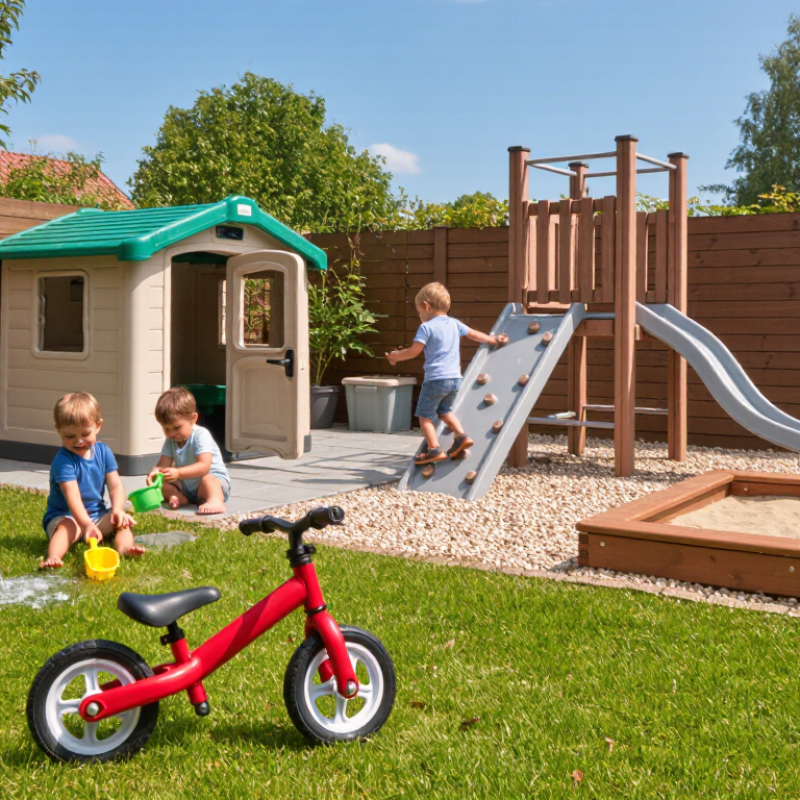
The play environment matters just as much. A humid coastal market requires rust-resistant materials and drainage. A cold region may need flexible plastics that resist cracking. Urban buyers may have only a tiled courtyard, so lightweight and foldable designs are practical. Rural buyers may value larger activity areas and easy-clean surfaces. I have seen product plans focus heavily on color and novelty, while ignoring storage space. That is a costly mistake. No checklist is perfect. Real users still behave unpredictably.
Evaluate Toy Safety, Materials, and International Compliance
Choosing outdoor toys for global buyers requires more than bright colors and weather-resistant packaging. Start with safety evidence. The U.S. Consumer Product Safety Commission reported 231,900 toy-related emergency-department injuries in 2023. Falls, collisions, and small detachable parts remain practical concerns. Inspect wheel joints, seams, handles, and battery compartments by hand. A smooth surface can still hide weak plastic.
Material review should include plastic composition, coatings, fabric dyes, and metal fasteners. Ask suppliers for recent laboratory reports covering heavy metals, phthalates, flammability, and small-parts testing. The European Union’s Safety Gate report recorded 3,412 dangerous-product alerts across consumer categories in 2023, showing why documentation cannot be treated as paperwork only. Check alignment with relevant standards, such as EN 71, ASTM F963, or ISO 8124, according to the destination market. Requirements differ. A report accepted in one country may not satisfy another authority. Keep batch numbers, test dates, factory details, and clear age warnings together. Also verify packaging labels and online product descriptions. They must match the tested product exactly. This is where many purchasing teams become careless. I have seen attractive samples pass visual checks but fail after repeated impact or water exposure. No checklist is perfect. Re-test when materials, molds, colors, or suppliers change.
Compare Durability, Weather Resistance, and Maintenance Requirements
How to Choose Outdoor Toys for Global Buyers?
Outdoor toys must survive more than enthusiastic play. They face sunlight, rain, frost, dust, and salty coastal air. Global buyers should compare material strength before choosing attractive colors or extra features. A durable toy uses thick, well-finished plastic, treated wood, or corrosion-resistant metal. Joints should feel firm, without sharp edges or loose caps. Check weight limits carefully. In my sourcing experience, sample testing often reveals weak hinges and thin panels that photos hide. A perfect appearance proves very little.
Weather resistance depends on the destination. Strong ultraviolet light can fade plastic and make some materials brittle. Frequent rain may cause swelling, mold, or hidden rust. Cold weather can reduce flexibility and create cracks after repeated freezing. Ask suppliers for outdoor exposure data and inspect drainage holes, seals, and surface coatings. No material is perfect. I once underestimated coastal humidity, and small fasteners corroded earlier than expected.
Maintenance affects the real cost. Choose surfaces that can be washed easily with mild soap and water. Avoid deep grooves where mud and moisture collect. Removable fabric parts should dry quickly and resist mildew. Buyers should request cleaning instructions, replacement-part availability, and inspection guidance. Monthly checks can reveal fading, splinters, loose screws, or damaged anchors. However, maintenance schedules differ by climate, so a standard checklist may need adjustment. That detail is easy to overlook. Reliable suppliers should explain test methods, expected service conditions, and known limitations clearly.
Select Suppliers by Quality Control, Pricing, and Global Support
How to Choose Outdoor Toys for Global Buyers?
Outdoor toy sourcing starts with measurable quality control, not attractive photos. A supplier should provide material declarations, batch records, and production samples. Ask for pull-force tests on handles, wheel assemblies, and small detachable parts. Check sharp edges, pinch points, paint adhesion, and UV resistance. For different markets, request evidence aligned with relevant safety standards, such as EN 71 or ASTM F963. Third-party laboratory reports should show product identifiers and test dates. Generic certificates are weak evidence.
Pricing needs a wider lens. According to Grand View Research, the global toys market reached approximately 108.7 billion dollars in 2023. Circana reported a 1% decline in global toy sales during 2023, showing that buyers face tighter demand conditions. Compare landed cost, not factory price alone. Include packaging, inspection, freight, duties, tooling, and defect allowances. A cheaper swing set can become expensive after replacement parts and customer claims. Do the math carefully.
Global support also matters. Reliable suppliers explain lead times, carton dimensions, spare-part policies, and complaint response procedures. Test communication with a small pilot order. Measure response speed and corrective action quality. No checklist is perfect. I would still inspect random cartons before shipment, especially after a material change. Suppliers should adapt instructions for language, climate, and installation habits. Clear manuals and realistic assembly images reduce confusion in warehouses and homes. Some buyers overlook this detail. Children and parents notice it quickly.
How to Choose Outdoor Toys for Global Buyers?
Supplier selection should balance product safety, cost efficiency, and international service capability. This 100-point benchmark gives the greatest weight to quality control while keeping pricing and global support essential for cross-border purchasing.
Benchmark weighting: Quality Control 40%, Pricing 30%, and Global Support 30%. Buyers can adjust the weighting according to destination-market regulations, order volume, and service requirements.