Leave Your Message
Educational Toys are no longer limited to flashcards, puzzles, or classroom manipulatives. They now include coding kits, construction sets, science experiments, language games, sensory products, and imaginative-play tools. This expansion reflects how children learn through movement, questioning, practice, and social interaction.
Industry data supports this wider view. Grand View Research’s Educational Toys Market Size, Share & Trends Analysis Report identifies STEM, digital learning, and problem-solving products as important market drivers. The Toy Association’s annual trend reports also highlight creativity, hands-on discovery, and technology-supported play. Circana’s global toy research shows that families remain selective, especially when household budgets are under pressure. They want meaningful play value. That matters.
However, market popularity does not automatically prove educational quality. A brightly packaged coding toy may offer limited learning if instructions are confusing. A simple wooden sorting game may build stronger early reasoning skills. Research from the American Academy of Pediatrics stresses that play should remain developmentally appropriate, interactive, and balanced with adult guidance. This principle helps separate useful Educational Toys from products built mainly around novelty.
This guide examines the top 10 types of Educational Toys through learning goals, age suitability, engagement, safety, and practical value. It considers what children actually do with each toy, not only what advertisements promise. No ranking is perfect. Children develop differently, and family circumstances vary. Evidence is mixed. Therefore, parents, teachers, and buyers should treat these categories as informed starting points, rather than rigid instructions.
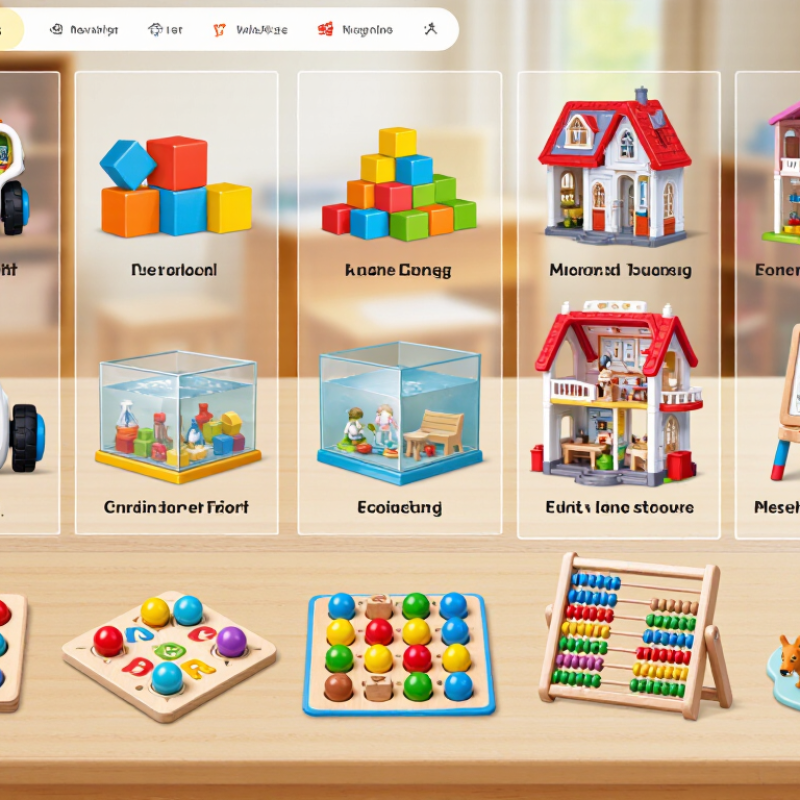
Educational toys are not defined by bright colors or a “learning” label. They are tools designed to build specific skills through active play, feedback, and age-appropriate challenge. A puzzle can strengthen spatial reasoning, while a pretend-play set can develop language and social judgment. In practice, the same toy may support several outcomes. That distinction matters.
A useful classification includes ten common types: building toys, puzzles, STEM kits, early mathematics toys, language and literacy toys, science experiment kits, art materials, pretend-play toys, sensory toys, and coding or robotics toys. These categories reflect the primary learning goal, not merely the toy’s appearance. Grand View Research estimated the global educational toys market at more than 60 billion U.S. dollars in 2023, with continued growth expected through 2030. The report suggests strong demand, but market growth does not prove educational quality.
Professionals should also classify toys by age, adult support, complexity, and feedback. A counting game for a preschooler may use wooden pieces and simple prompts. A coding toy for an older child may require sequencing, testing, and correction. The OECD’s PISA framework emphasizes problem-solving, creative thinking, and applying knowledge, which are useful benchmarks for evaluating play materials. Circana’s global toy industry reporting has also shown changing consumer demand and pressure on household budgets. Therefore, durability and repeat play deserve attention. The categories overlap. That is a limitation. A well-designed toy should invite children to make choices, notice mistakes, and try again, rather than follow one fixed answer.
What Defines an Educational Toy and How Are These Toys Classified?
| No. | Educational Toy Type | Primary Learning Area | Typical Examples | Common Age Range | Classification Basis | Main Skills Developed |
|---|---|---|---|---|---|---|
| 1 | Building and Construction Toys | STEM and spatial reasoning | Interlocking blocks, magnetic tiles, engineering construction sets | 2–12 years | Classified by the use of parts to design, assemble, and balance structures | Planning, creativity, fine-motor control, geometry, and problem-solving |
| 2 | Puzzles and Logic Games | Cognitive development | Jigsaw puzzles, pattern games, sorting activities, and sequencing tasks | 2–12 years | Classified by the need to identify relationships, patterns, or solutions | Memory, concentration, visual discrimination, reasoning, and persistence |
| 3 | Science and Experiment Kits | Scientific inquiry | Magnets, plant-growing kits, weather tools, and observation equipment | 5–14 years | Classified by hands-on investigation, observation, testing, and recording | Questioning, evidence-based thinking, measurement, and cause-and-effect reasoning |
| 4 | Math and Counting Toys | Numeracy | Counting counters, number tiles, balance scales, and fraction manipulatives | 3–12 years | Classified by the use of physical objects to represent quantities and relationships | Counting, classification, comparison, calculation, and proportional thinking |
| 5 | Language and Literacy Toys | Communication and reading readiness | Alphabet tiles, storytelling cards, phonics activities, and word games | 2–10 years | Classified by activities that build spoken language, symbols, sounds, or print awareness | Vocabulary, listening, phonological awareness, storytelling, and early reading |
| 6 | Coding and Robotics Toys | Computational thinking | Screen-free coding cards, programmable devices, and beginner robotics sets | 5–14 years | Classified by sequencing instructions, testing outcomes, and debugging solutions | Algorithms, sequencing, logical reasoning, collaboration, and troubleshooting |
| 7 | Art and Creative Expression Toys | Creativity and self-expression | Drawing materials, modeling compounds, craft sets, and design activities | 2–12 years | Classified by open-ended creation using visual, tactile, or design processes | Imagination, hand strength, coordination, visual planning, and emotional expression |
| 8 | Pretend-Play and Role-Play Toys | Social and emotional learning | Dolls, pretend food, occupational play sets, costumes, and play environments | 2–8 years | Classified by symbolic play, imitation of real-life roles, and collaborative scenarios | Communication, empathy, negotiation, self-regulation, and social understanding |
| 9 | Musical and Rhythm Toys | Auditory and creative development | Shakers, drums, xylophones, rhythm cards, and simple instruments | 1–10 years | Classified by activities involving sound production, rhythm, listening, or musical patterns | Auditory discrimination, timing, memory, coordination, and expression |
| 10 | Motor-Skill and Sensory Toys | Physical and sensory development | Stacking rings, lacing boards, textured materials, balance equipment, and activity panels | 0–8 years | Classified by the sensory input or physical movement required to complete an activity | Balance, coordination, dexterity, body awareness, and sensory processing |